
Silver Falls Thru' 1980 and 2011 Peak at $50 as Gold Sinks
GOLD and SILVER PRICES continued to drop on Friday, hitting 1-year and 11-month lows respectively even as bond yields and interest-rate expectations fell following this week's "no change" decisions from the US Fed, European Central Bank and Bank of Japan.
Losing 1.4% for the week, the spot price of gold in global trading and storage hub London dropped as low as $3937 per troy ounce, down below end-June's 7-month gold low to the cheapest since the end of October last year.
More industrially-useful silver meantime sank 8.0% from last Friday and fell through $50 per ounce − previously its all-time high in 1980 and 2011.
This New Year silver surged as high as $121 amid a global deficit of silver supply to meet demand, plus localized shortages of retail bar and coin products and projections of runaway use by the photovoltaic solar energy sector.
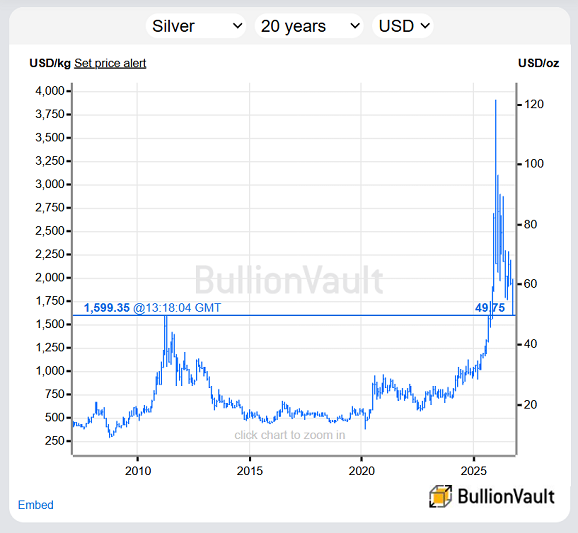
Here in late-2026, and "beyond weak physical investment, elevated [silver] prices continue to weigh on jewellery and silverware consumption," says the latest weekly bullion-market analysis from specialists Metals Focus, "while ongoing thrifting and substitution, particularly in photovoltaics, are reducing industrial silver demand.
"As a result, the silver market deficit is expected to narrow further this year, with a return to surplus projected for next year, reducing the likelihood of a repeat of the extreme physical market squeeze.
"[But] once markets scale back expectations of aggressive monetary tightening in 2027, silver could start to outperform," says Metals Focus, noting that the recent jump in gold's relative pricing − which put the Gold/Silver Ratio at its highest so far in 2026 above 79 on Friday − "remains relatively low compared with levels seen in recent years, averaging 82 during 2020-25."
Gold in London this morning set its lowest LBMA Gold Price benchmark in US Dollar terms since the start of July, fixing around $3981 per troy ounce at the City's 10:30 auction.
That global benchmark peaked at $5501 on the last day of January, with the spot price of gold spiking nearly $100 per ounce above that.
Long-term bond yields eased lower, with the US government's 10-year borrowing cost dipping beneath 4.90% per annum for the first time since mid-September.
Betting on the US Fed's overnight interest rates also eased back, albeit with a rise at the US central bank's December meeting seen as a 70% certainty with 2027 now expected to deliver at least 1 further rate rise on top.
Following the US Fed's "hawkish" hold Wednesday, yesterday's economic data said US GDP accelerated to 3.4% annualized growth in July-to-September after accounting for inflation, which slowed hard from the spring's 4-year high on both the GDP Prices Index and the PCE measure.
The 21-nation Eurozone saw real GDP growth beat analyst forecasts for Q3, accelerating 0.1 points on today's data to 1.3% per year.
The European Central Bank yesterday held interest rates for the 350-million citizen currency union unchanged as expected, while Christine Lagarde said she is standing down as President next February, a move widely seen by German and other European media as enabling the region's political leaders help choose her replacement before April's elections in France.
Opinion polls currently put anti-Euro, anti-EU National Rally leader Marine Le Pen far ahead of left-wing rival Jean-Luc Melenchon, who wants to write-off that portion of France's national debt held by its domestic central bank.
"Underlying inflation has reached levels consistent with our price target," said Bank of Japan Governor Kazuo Ueda in Tokyo today, holding Yen interest rates unchanged but effectively declaring victory over more than 3 decades of deflation despite new data for September showing a drop in retail sales, new house-building and also construction orders.
Japan's stock market fell Friday, as did equities in China and South Korea, again led by chipmakers amid fast-spreading concerns over the AI debt bubble, with New York's Nasdaq 100 set for another steep drop at the market's opening while European bourses also fell.
With gold losing 5.6% for the month of October, so-called cryptocurrency Bitcoin meantime headed for a 3.3% weekly drop, trading at the lowest in 5 weeks as analysts blamed hackers in North Korea for stealing $6.4 billion of crypto from customers of major wallet-and-exchange provider Binance.










 Email us