
Gold Makes Half-Year Loss on Highest Volatility Since Lehman's Crash
GOLD and SILVER PRICES rose above last night's new 7-month lows in volatile trading on Tuesday, but the former monetary precious metals recorded a half-year loss for the first time since 2022 and 2023 respectively as June ended with a further rally in global stocks, the US Dollar, and US interest-rate expectations.
Trading 26.7% below end-January's all-time London benchmarking high above $5500 per troy ounce, gold today set a 3pm London auction price beneath $4030, dropping 6.5% from New Year's Eve.
In contrast, the US stock market traded 8.9% higher than New Year's Eve, while Brent crude oil rose 21.8% for 2026 to date, albeit back down to levels last seen in early March, start of the US-Israeli war on Iran, as envoys from President Trump landed in the Middle East, seeking to continue peace talks despite fresh exchanges of fire.
Over the first 6 months of 2026, gold has shown greater volatility day-to-day than any half-year average since the second half of 2008.
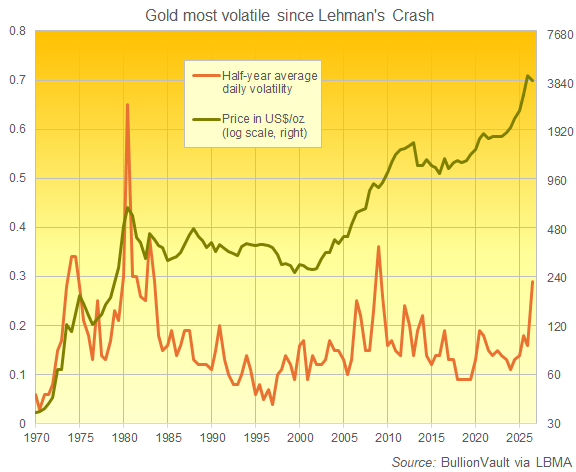
Over the last 6 months of 2008, gold moved 42.4% low-to-high as the collapse of Lehman Brothers flipped the Western banking crisis into a global financial crash, spurring the most violent volatility in gold prices since the early 1980s.
So far in 2026, gold's end-January peak was 37.7% above last Friday morning's 7-month low, struck as betting leapt that US central bank the Federal Reserve will soon start raising Dollar interest rates to try cooling inflation.
"[Gold's New Year] bubble has now corrected," says economist and FX strategist Robin Brooks at the Brookings Institute think tank in Washington.
"First, the massive scale of last year's rally sucked in lots of retail investors...a lot more skittish than the previous buyer base.
"Second, markets have convinced themselves that the Fed is shifting in a hawkish direction under [new chairman Kevin] Warsh.
"Third, any [central bank] reserve manager will have been looking at price action in recent months, wondering what's up...turning more cautious [on gold because] the Dollar has been much more of a safe haven" during the US-Iran war.
Gold tumbled overnight in China, hitting the lowest benchmark price in Shanghai since end-September at ¥864.5 per gram − down 2.7% below Monday morning's SGE Fix − before rebounding sharply to finish June at ¥879.
Losing 9.7% in Yuan terms since the last day of December, that put Shanghai's 2:15pm benchmarking auction $38 per ounce above spot-market quotes for London settlement.
That was almost 4 times the average incentive offered for new gold imports into the No.1 consumer nation so far in 2026, and the highest since early May.
Silver meanwhile rallied on Tuesday afternoon close to $60 per troy ounce in London's spot market after setting a 12 noon auction price around $58.80.
That gave the more industrially-useful precious metal a half-year loss of 18.3% in US Dollar terms, its first drop since H1 2023 and the steepest since H2 2014 marked the end of its post-financial crisis bear market.
Base metal copper, in contrast, showed a 9.1% first-half rise.
The US stock market hasn't shown a half-year fall since the 20.6% plunge of H1 2022, when post-pandemic inflation got a boost towards double-digits across the rich world − driving interest rate expectations higher as bond prices sank − thanks to surging energy prices and Russia's all-out invasion of Ukraine.
Western government bonds today showed a small drop in price for 2026 to date, with the TLT ETF of longer-dated US Treasury debt showing less than a 0.1% valuation change overall, interest payments included.
The US Dollar meantime rose towards last week's 14-month high on its DXY index after hitting a 4-year low in mid-January.









 Email us