
Silver and Gold Crash as Iran War Kills Interest-Rates Cuts
SILVER CRASHED and GOLD sank to $4600 per Troy ounce on Thursday, with the 'safe haven' down more than 5% after the US Federal Reserve was joined by Canada, Japan, the UK and the 20-nation Eurozone in keeping interest rates unchanged in the face of sudden economic and inflation "uncertainty" as the US-Israeli war with Iran continues.
Almost erasing the last of 2026's previous 30% spike, the Dollar price of gold fell more than $1000 below end-January's all-time gold price spike.
The price in Euros meantime dropped through €4000 − a new all-time high 9 weeks ago − while the UK gold price in Pounds per ounce fell below £3400, down more than 10.5% for the week so far.
Stock markets now including China also plunged as Iran hit oil and gas infrastructure across the Middle East in retaliation for Israel's strikes on its giant South Pars field, with the MSCI World Index down for the 9th session in 14 since this war began as European bourses lost over 2.1% for the day.
"I think it appropriate to see us pausing to take stock," says New York academic and now UK central bank policymaker Alan Taylor, "but inappropriate to infer a directional shift from this meeting."
"Risks to growth look tilted to the downside [but] inflation risks have gone up due to higher energy prices," said the Bank of Canada yesterday.
"The war in the Middle East has made the outlook significantly more uncertain," said today's monetary policy statement from the European Central Bank.
"Future developments warrant attention," said the Bank of Japan overnight, also voting to keep the cost of borrowing unchanged.
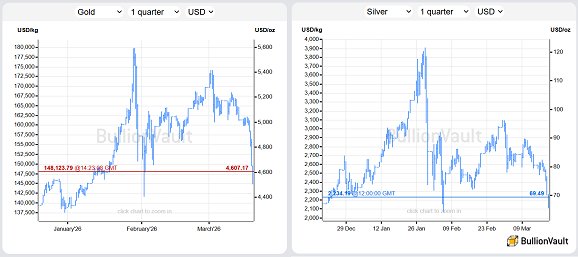
Silver prices outran gold bullion's plunge on Thursday, losing 11.0% in Dollar terms by midday in London before crashing as much as 21.7% for the week so far at a sudden 6-week low of $65.55 per Troy ounce.
Fresh investment outflows yesterday saw the giant SLV silver-backed ETF trust fund shrink to its smallest in 4 months.
World No.1 gold ETF the GLD shrank again, down for the 5th session in a row to the smallest since New Year as its No.2 competitor by size shrank to its smallest since the end of September.
"There is tension between our two goals," said US Fed chair Jerome Powell yesterday following the US central bank's decision to keep both current Dollar interest rates and its 'dot plot' forecasts unchanged, even while crude oil jumps to $100 per barrel.
"[We face] upward risks for inflation and downward risks for employment, and that puts us in a difficult situation."
With betting on the US Fed's key interest rate now predicting no cuts until June 2027 − twelve months later than the market's pre-war prediction − the price of gold today lost 5.1% from Wednesday's London finish, the 45th steepest daily drop ever.
The worst came on 22 January 1980, when the 'safe haven' lost 13.2% and began a 2-decade bear market after spiking to the $850 big top in gold as the inflationary 1970s ended with higher interest rates and deep economic recession.
That's followed by gold's 12.1% plunge of 28 February 1983 and then the 9.1% plunge of 15 April 2013, when the US Fed triggered a Taper Tantrum in bond prices when it began discussing a reduction of QE asset purchases, plus the end of zero interest rates, as the financial crisis receded.
"A possibility which might also be contributing to lower gold prices is central banks turning into net sellers," says a note from analyst Bernard Dahdah at French investment bank Natixis.
Following post-WW2 record demand for gold among reserve managers, "Some central banks could be [selling] to defend their currency as the Dollar has surged or to fund oil purchases."
The world's heaviest gold-buying central bank of the past 3 years on official data, the National Bank Poland has proposed using the unrealized gains on its gold bullion reserves − now larger than the European Central Bank's − to help fund defense spending as an alternative to the ruling coalition's preferred use of cheap loans from the European Union's Security Action for Europe (SAFE) scheme.









 Email us