
Gold Erases Early Rally as WGC Reports First-Half Central Bank Buying at Lowest Since 2022
GOLD and SILVER PRICES erased early gains on Monday and slipped below Friday's close as oil prices pared an earlier slump, with investors also digesting President Donald Trump's weekend announcement that fresh talks with Iran would begin Monday, while the US Dollar weakened following last week's US-Japan joint intervention. The latest World Gold Council report showed that central bank gold buying slowed to its weakest first-half pace since 2022, writes Atsuko Whitehouse at BullionVault.
Spot gold jumped as much as 1% to $4080 per ounce on Monday morning before giving back all its gains. Brent crude, meanwhile, pared its earlier loss of more than 7% to a one-week low after Trump agreed to call off a massive attack on Iran as allies in the Middle East urged him to pursue diplomacy instead. The OPEC+ cartel of producer nations also agreed over the weekend to increase production quotas by approximately 188,000 barrels per day from September, which also weighed on prices.
The Dollar Index - a measure of the US currency against its major peers - fell to a more than six-week low as traders remained alert for signs that last week's coordinated intervention by Japan and the United States could be followed by further action.
Japan reportedly spent more than US$60 billion supporting its currency last week, while the US Treasury is believed to have bought between US$5 billion and US$10 billion worth of Yen. The operation marked the first joint intervention since March 2011, when the Yen surged following the Great East Japan Earthquake. It was also the first Yen-buying intervention since the Asian financial crisis in 1998.
The intervention coincided with the publication of the World Gold Council's latest quarterly report.
The latest supply-and-demand report showed that central bank gold sales slowed sharply in the second quarter. Turkey, the largest seller in the first quarter as it used gold reserves to support the lira, sold just 4 tonnes while reducing its outstanding gold swaps from more than 80 tonnes to around 60 tonnes. Russia became the largest seller during the quarter, reducing its holdings by 22 tonnes as it drew on reserves to help finance its widening budget deficit amid weaker energy revenues and elevated military spending.
"Market coming around to fact Central Banks flows increasingly more 2-way, vs 1-way," said Nicky Shiels, Head of Metals Strategy at MKS PAMP.
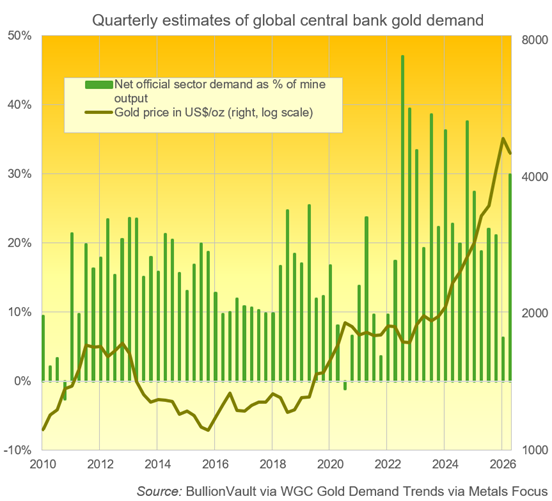
Against that backdrop, the WGC reported that central bank gold buying recovered to 289 tonnes in the second quarter. However, the stronger quarterly figure was not enough to offset a sharp downward revision to first-quarter net purchases, from 244 tonnes to 57 tonnes, leaving first-half demand at 345 tonnes - the lowest first-half total since 2022.
Central banks' share of global mine production has therefore fallen to its lowest level since 2021, marking the weakest pace of official-sector buying relative to newly mined supply since before Russia's invasion of Ukraine. That was the last full year before reserve managers embarked on an unprecedented wave of gold accumulation following Western sanctions on Russia and the freezing of a large portion of the Russian central bank's foreign exchange reserves.
Central bank gold buying subsequently surged to 1,080 tonnes in 2022 - almost one-third of annual global mine production - and remained exceptionally strong thereafter, although annual purchases fell below the 1,000-tonne mark for the first time in four years in 2025. Even after the latest revision, official-sector demand remains well above pre-2022 levels, averaging nearly double the 512 tonnes purchased annually over the preceding decade.
The WGC said the revision reflected the reclassification of some purchases previously attributed to official-sector buyers into the "OTC and other" category, rather than newly identified central bank selling.
"It has become a bit of a game of cat and mouse," said John Reade of the World Gold Council, adding that central bank purchases have become increasingly difficult to track as disclosure has declined since 2022.
"The revision [is] a data-integrity event, not a demand event," commented Shiels, noting that quarterly estimates of central bank buying should be treated as provisional until verified against official disclosures, IMF data and trade flows.
Among reported buyers, the National Bank of Poland remained the largest purchaser during the first half of 2026, adding 82 tonnes, including 51 tonnes in the second quarter, increasing its gold reserves to 632 tonnes by the end of June and bringing it closer to its 700-tonne target.
The People's Bank of China followed, adding 40 tonnes during the first half through steady monthly purchases, including 8 tonnes in April, 10 tonnes in May and 15 tonnes in June, as gold prices retreated. China's latest reserve data for July will be published on Friday.
To summarise the quarter, total global gold demand held steady at 1269 tonnes, supported by the rebound in central bank buying and firm bar-and-coin investment of 307 tonnes. Those gains offset ETF outflows of 45 tonnes and the weakest jewellery demand since the pandemic at 278 tonnes.
Silver - around 60% of whose annual demand comes from industrial applications - climbed as high as $58.63 per ounce earlier on Monday before surrendering all those gains and falling further to $56.65.
Currency markets also remain in focus after Japan's joint intervention with the United States last week. Japanese Finance Minister Satsuki Katayama said Tokyo stands ready to act again against "excessive volatility" if necessary, while US Treasury Secretary Scott Bessent said Washington would support further coordinated action should disorderly market moves persist.
Markets will continue to monitor developments in the Middle East and their potential impact on energy prices and investor sentiment. On the economic calendar, attention this week will turn to the US labour market, with the JOLTS job openings report due on Tuesday, the ADP employment report on Wednesday, and non-farm payrolls (NFP) on Friday.









 Email us