
Gold Erases 2026 Gains as Central Bank Selling Hits Headlines
GOLD PRICES held over $300 per ounce above yesterday's 4-month crash on Tuesday but erased the last of 2026's previous 30% gain, lagging the rebound in silver after new data showed the Central Bank of Russia selling gold again in 2026, while rumours said Turkey may sell or borrow against its gold reserves to try defending the Lira.
Now the 5th and 11th largest national central bank gold holders in the world, Russia and Turkey have both grown their bullion reserves more than 5-fold by weight since the year 2000.
But the Central Bank of Russia began selling gold in 2025 to help fund the Kremlin's war in Ukraine, while the Turkish Lira today hit another fresh record low versus the Dollar, its 11th since the US-Israeli war on Iran began 16 trading days ago.
Last week the National Bank of Poland − the heaviest gold buying central bank of the past 3 years − suggested tapping the unrealized profits from its huge gold accumulation to help fund the government's defense spending, rather than taking out loans from the European Union's new 'SAFE' scheme.
"It is likely that some central banks are selling gold to defend their currency and/or to fund energy purchases," says French investment bank Natixis' commodities analyst Bernard Dahdah.
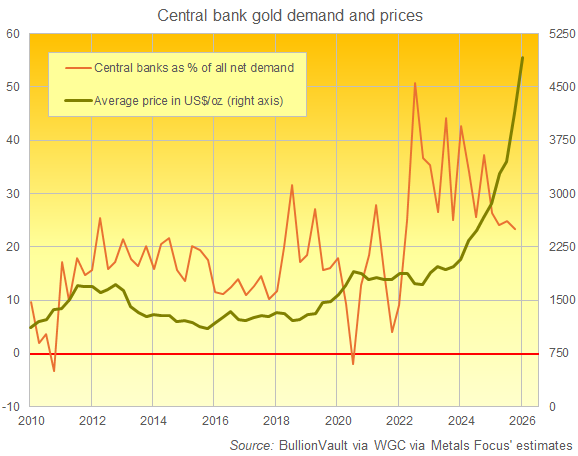
Demand from central banks fell last year below 25% of total net demand worldwide, down sharply from the prior 3 years' average of 33% but still sharply above any level seen between the end of the US Dollar-gold exchange system in 1971 and the start of Russia's invasion of Ukraine in 2022.
Now "Turkey mulls tapping $135 billion gold reserves for Lira defense," says Bloomberg News, quoting un-named officials in a story not yet reported by Turkish media about how the Central Bank of the Republic of Turkey could borrow against the bullion it holds at the Bank of England in London.
Latest data from the CBRT says that, at the end of 2024, Turkey held over 111 tonnes of its central-bank gold reserves at the Bank of England. Some 1/5th of its national reserves, that was sharply higher from the multi-year lows of 2019 when Turkey pulled its gold out of London amid political arguments with the UK and other US-led Nato alliance partners.
Gold selling by the Central Bank of Russia in January and February has now taken its bullion reserves down to a 4-year low by weight, raising perhaps $2.4 billion so far based on this year's month-average prices to date.
"Nobody's stopping us from selling gold, taking a profit, and then buying it back some time later," said Poland's central bank governor Adam Glapiński 2 weeks ago, offering to fund the country's fast-growing defense spending but apparently rejected by the pro-European Union administration of Prime Minister Donald Tusk.
That extends the political row between Tusk and the NBP senior management − appointed by the previous Russia-friendly PiS Government − who declared on its website in December that it now owns more gold than the European Central Bank, calling itself "Europe's golden power".
Gold prices today dipped back through $4400 per Troy ounce before fixing at London's 3pm auction around $4420, the lowest since the first trading day of 2026.
End-January's spike saw gold peak 29.5% above its New Year level.
Silver meantime rallied above $70 per ounce today, more than reversing the last of Monday's 10.2% plunge prior to US President Trump making a 'taco' and delaying his threat to destroy Iran's domestic power generation capacity.
Pakistan said it's willing to host US-Iran talks − talks which Trump yesterday said were already well underway, but flatly denied by Tehran.
QatarEnergy meantime declared force majeure on long-term liquefied natural gas (LNG) contracts for customers in Italy, Belgium, South Korea and China.
"[While] gold prices could come under downwards pressure for the foreseeable future (as central banks try and soften the impact of rising energy costs and weaker currencies)," says Dahdah at Natixis, "we could see opportunistic buying, mainly from China which could provide a floor under prices, as we saw back in 2015" at the bottom of the precious metal's post-financial crisis bear market.









 Email us