
Gold Sinks Again But Central Banks 'Still Buying Heavily'
GOLD PRICES fell to new 4-week lows against the Dollar, Euro and Sterling on Wednesday as new data said that central banks have continued to buy the 'safe haven' metal but the Iran War energy-price shock worsened.
With the USA and Iran both blockading the vital Strait of Hormuz, "No more Mr.Nice Guy!" said an AI image of Donald Trump − carrying an assault rifle against a war-torn desert backdrop − tweeted by the President overnight.
"Iran can't get their act together," Trump said. "They better get smart soon!"
Brent crude leapt above $115 per barrel, a new 4-year high almost 60% higher from the eve of the US-Israeli attacks on Iran.
The price of gold in contrast dropped to $4540 per Troy ounce, extending its loss so far this week to 3.6% so far in US Dollar terms and hitting 5-week lows against surging 'commodity currency' the Australian Dollar.
After official data for March said that central banks were heavy net sellers of gold as this Middle East war began, "The conflict involving Iran, the US and Israel added to an already fraught geoeconomic environment," says the latest quarterly supply-and-demand report from the mining industry's World Gold Council, "driving greater volatility across markets including gold.
"Continued central bank gold demand against this backdrop underscores the broadly strategic nature of their purchases and continued confidence in gold’s role as a store of value during periods of uncertainty."
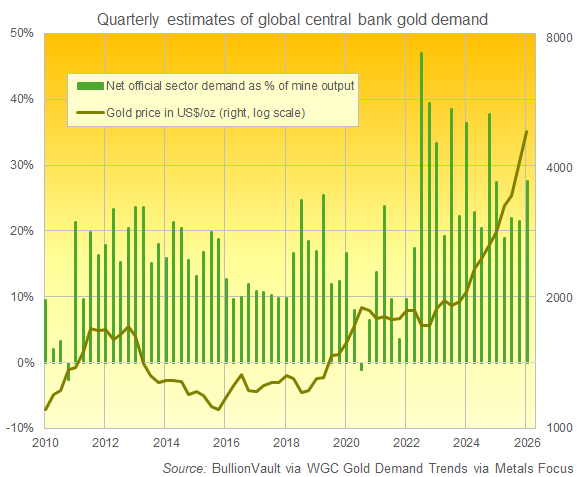
Using data and analysis from specialist consultants Metals Focus, today's Gold Demand Trends for Q1 includes an estimate of central bank gold demand, widely believed to be greater than the sector's officially reported data suggests.
Despite gold prices averaging a new quarterly record near $4873 per ounce in January-to-March, the report puts central bank demand at the 7th heaviest 3-month total on current records, some 7.8% greater than the past 5-year quarterly average by weight at 243 tonnes.
But analysis by BullionVault of the available official data so far says that while 8 central banks bought 63 tonnes of gold between them in Q1, the Central Bank of the Republic of Turkey sold and borrowed against 118 tonnes, cutting its total gold holdings − including commercial bank bullion held as part of their required reserves − below 700 tonnes for the first time since Q3 2023.
"Nothing changed regarding the long-term thesis," says a report about central-bank gold sales for Bloomberg News from derivatives exchange the CME. "What changed is that the crisis they were preparing for actually arrived."
"Gold is the most liquid non-Dollar asset they have. So, they're selling it, not because they're wrong about gold, but because it's working exactly as it's designed."
"Precious metal returns often increase as geopolitical stress emerges," says the latest commodities market review and outlook from international lender the World Bank.
"[But] blistering rallies in early 2026 [have] subsided as the conflict escalated. This atypical pattern likely reflects a partial reversal of the speculative fervor that gripped precious metals markets in recent months, extending a spell of extraordinary volatility."
With gold down again Wednesday, more industrially useful silver − which currently finds no reported central bank demand − meantime fell through $72 per Troy ounce for the first time in 3 weeks, down 4.1% from last Friday's London benchmarking auction.









 Email us