
LBMA 2026 Conference: Short-Term Cautious, Long-Term Bulls
Gold prices set to continue relentless bull market...
SORRENTO in Italy is a lovely town if you like sea, sun and lemons, writes Adrian Ash in this review of the gold market's 2026 LBMA/LPPM conference first shared with Weekly Update readers on Tuesday.
Lemon-themed tea towels, cooking aprons, fridge magnets...you name it.
Plus, of course, gallons of Limoncello all bottled and ready for you to take home (or gift) and then forget about at the back of your drinks cupboard.
The start of October found 1,000 people from the global precious metals market gathered there for the annual LBMA/LPPM conference.
What might they be overlooking at the back of their dusty cupboards?
First up, central banks...
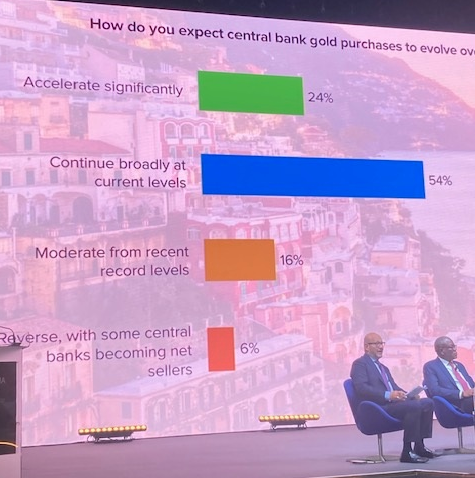
Read or watch pretty much any commentary on the price of gold right now, and the consensus is plain:
Short term, the soaring cost of borrowing is hurting the gold price. But long term, that's offset by strong and continued gold buying by central banks.
Most attendees in Sorrento share that view, as the poll above shows.
The world's 2nd biggest (official) holder said the same, too.
"The recent rise in global government bond yields has boosted the relative attractiveness of debt securities again," explained Joachim Nagel, President of Germany's Bundesbank in his excellent speech on Day 1.
"At the same time, rising debt levels have increased concerns about the credit risk of these assets. Furthermore, geopolitical risks are likely to continue to shape reserve management decisions.
"Taken together, the case for further diversification into gold remains significant."
Hence the poll of conference attendees above, taken during this year's excellent central-bank panel, entitled "Drivers, Strategies and the Future of Official Reserves."
The panel brought together central bank reserves managers from Italy, Ghana, Poland, Mexico and South Africa.
That proved a fantastic and very educational mix. Because while they all hold a substantial part of their central bank reserves in gold, their activity in gold is as diverse as their history, cultures and cuisine.
Italy, for instance, is the axiom of "legacy" holder...
...starting to acquire bullion in 1893, height of the global Gold Standard, after first becoming a country barely 3 decades earlier...
...using it as "the cornerstone for confidence" in its new currency, the Lira...
...before hiding a chunk of it behind a brick wall built overnight when the Nazis took over in 1943...
...then rebuilding its reserves in the post-war boom of the 1950s and '60s...
...using a chunk to raise an emergency loan from the German Bundesbank in the oil-price crisis of 1973...
...before pooling part of its reserves to launch another new currency, the Euro, in 1999...
...then fighting off the advances of various elected governments wanting to sell Banca d'Italia gold or tax the value of Italy's gold to fund their budget deficits...
...and now treating gold as an "intermediate asset" among its reserves, ignoring what econometric models say about buying or selling day-to-day even while it "brings a lot to the asset allocation process."
Not least, it's brought gold back up to 30% of Italy's FX reserves, the level it represented at the turn of the millennium...
...thanks to its value outrunning QE bond buying rather than any change whatsoever in the quantity which the Banca d'Italia owns over the past quarter-century.
Ghana, in contrast, has only just begun accumulating gold, buying it from domestic mines and aiming to turn this natural resource...
...which accounts for nearly half of the country's total exports...
...into a "monetary buffer" to protect the Cedi, now stabilizing above the record lows of 2024 on the foreign exchange market.
Mexico isn't buying gold, but it's not selling either...
...taking instead a dynamic approach via the derivatives market to raise or reduce its exposure (and also trading silver by the way, but only for local mining producers and the Mexican government's Casa de Moneda coin-minting program).
South Africa has meanwhile lost its crown as the world's No.1 gold miner to China and as Africa's No.1 to Ghana.
But while it isn't buying or selling right now, it might maybe think about putting a little perhaps on deposit with commercial banks, not because the gold interest rates offered are high but because it's come to represent such a big share of Pretoria's foreign reserve assets.
Which brings us to Poland.
"We must start with Poland," said the panel's moderator Massimiliano Castelli, Head of Strategy, Sovereign Institutions at Swiss banking giant UBS's asset management division, opening the discussion last Tuesday.
That's because the NBP's headquarters in Warsaw are currently draped in a massive banner, Castelli explained, emblazoned with the number "700"...
...meaning the target number of tonnes which Poland's central bank wants to hold in its gold reserves.
Last month it got to 673. No one seemed concerned enough to even ask whether that, therefore, means that the world's single official gold buying central bank of the 2020s is about to stop buying.
Fading the tonnage question in favour of the percentage problem, "What is gold's proper share in reserves?" mused the NBP's chief dealer of FX and gold on the panel, or words to that effect.
"There is lots of analysis" around setting a percentage target, he said...
...such as Italy's current ratio of 30%.
"But with open conflict on our border, geopolitical tensions are our No.1 concern."
And for clarity, "The aim is not to replace the US Dollar or Euro. It's to become more diversified."
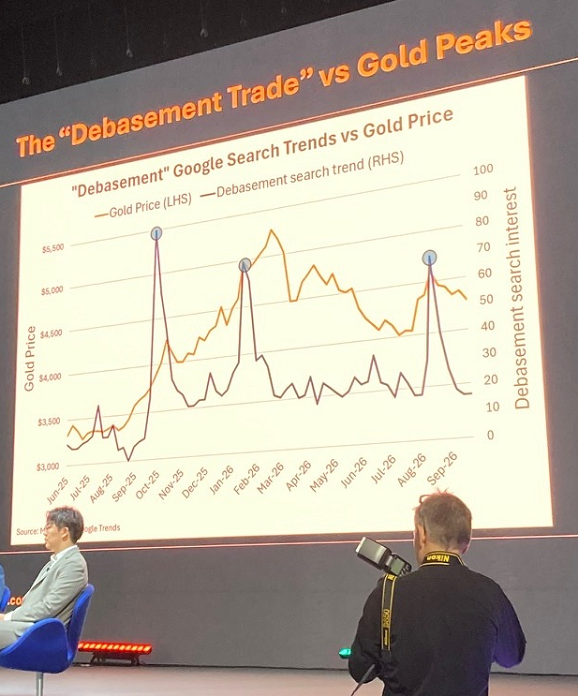
Cue big chart No.2...
The double D's got a starring role yet again at the 2026 LBMA/LPPM conference:
De-Dollarization.
Debt debasement.
On the first, many speakers said the same as Poland's central bank speaker.
"Dissatisfaction without displacement," quipped the guy from UBS...
...giving the financial world a fresh pair of D's and noting that he sees "no change in composition" of official, reported central-bank reserves worldwide.
The threat of debasement, however, was seen driving a big part of the past 18 months' surge in precious metals prices. Not least in the chart above, shared by Nicky Shiels, precious metals strategist at Swiss bullion refining and finance group MKS Pamp, as she moderated this year's Investment Panel.
The big jumps in gold's price came as internet search volumes leapt for 'debasement', she noted.
"Gold's daily returns have been positive during Asian hours, less so in Europe and US trading," said another participant, or so my scribbled notes now claim.
"The reason gold isn't still at $5000 or trading at $10,000 is because US institutional investors still aren't involved," said another, meaning pension and insurance funds.
The catalyst for them buying gold, said a fourth, will be the bond market. The sheer scale of new supply to the debt market simply won't let yields come down, making it hard for sellers in a buyer's market. So last year was odd, because the jump in gold prices didn't alert institutional investors that there's big trouble coming in bonds.
"I think it will happen in time."
But how much will those institutional investors have to pay to buy gold if they keep delaying like this?
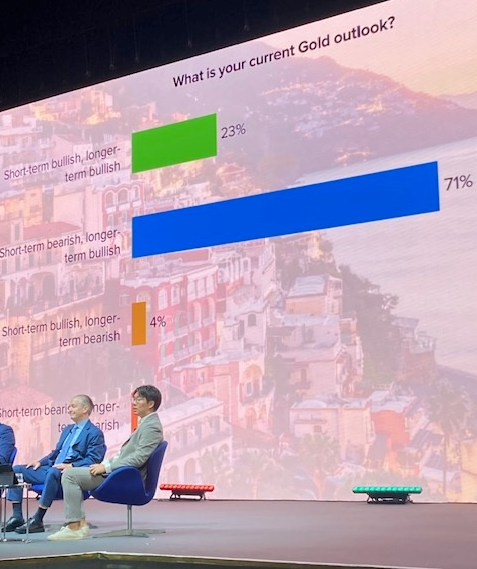
At first glance, you might think this poll of LBMA conference delegates asked the same question and got the same results as the first poll at the top of this report.
That's because this poll of delegates' price outlook maps the very same sentiment...
...foreseeing higher prices ahead, thanks no doubt to that near-unanimous expectation that central banks will just keep buying or even accelerate their demand.
Indeed, the average attendees' price forecast for gold actually rose during last week's conference...
...starting the Monday morning at $4895 per troy ounce for the next time we meet in 12 months' time...
...and rising $120 or so to $5013 by the final poll on Tuesday afternoon.
This year's conference, in other words, amplified the bullishness among delegates, whether from chit-chat over drinks or during business meetings, or from attending the conference's formal sessions.
And no wonder. Even the most bearish speaker was long term bullish. Paraphrasing again:
"Traditional demand [ie, for gold jewellery] has come down 10-20%. So we don't know where the market floor comes in, because the price rose too far too fast for Asian consumers to keep buying or indicate where they might jump in.
"That's why I'm cautious medium to short term."
But "short to medium" is a moveable time-frame, however. And so for the other precious metals, the average LBMA/LPPM attendee forecasts that silver will jump back towards $100 per ounce by next October's conference in Vienna...
...while platinum rebounds above $1900 and palladium trades back above $1400.
Long story short, the precious metals supply chain expects prices to resume the uptrend which peaked 8 months ago. Not quite the complacent bullishness shown at 2022's event, nor the blow-off bullishness shown as the gold price began sinking from its ultimate financial-crisis peak of autumn 2011.
But bullish all the same on a 'long term' view that tomorrow will look much the same as today. Even though today is so very different from before.










 Email us