
Gold and Silver Trading Drops as 'Bad Inflation' Hits China GDP
GOLD and SILVER PRICES struggled to repeat yesterday's spike on Wednesday, trading 1.0% and 2.5% lower for the week so far as weak US inflation data was followed by the weakest GDP growth in China since the Covid pandemic.
The world's 2nd largest economy and No.1 gold consumer saw GDP grow 4.3% per year in April-to-June after accounting for inflation, marking its slowest pace since 2022's wave of the virus.
Costs across the Chinese economy showed a 1.9% rise, snapping over 3 years of negative GDP deflator readings and helping "suggest that the imbalance between supply and demand has eased and deflationary pressure is moderating," according to Peking University's economic research director Su Jian.
"[But] the higher price level is cost-push − we can call this ‘bad inflation'," says Raymond Yeung, chief economist for Greater China at Australasian bank ANZ, albeit welcoming "positive inflation expectations [as] better for the economy than remaining stuck in a persistent deflationary trap."
Crude oil prices rose again Wednesday, trading up to the highest in nearly 5 weeks at $86.50 per barrel of September Brent as the US and Iran continued exchanging fire around the Strait of Hormuz and wider Middle East despite President Trump rowing back from trying to impose a 20% toll on cargo passing through the now Iran-controlled waterway.
"If anything, [the worsening war] should be a tailwind for gold as a mitigator of risk," says analyst Rhona O'Connell at brokerage StoneX.
"[But] the Shanghai onshore price [for gold delivered in China has been] showing only a tiny premium to loco London, reflecting a quiet market, while there is [also] little activity in the Middle East of South Asia."
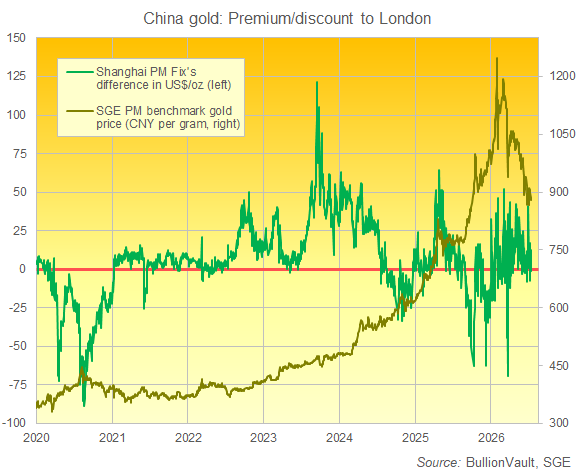
"The professional [gold investment] market is not much better," O'Connell at StoneX goes on, "as investors and traders remain reluctant to commit in any size while the international tensions continue to fluctuate."
Giant gold-backed investment ETF the SPDR Gold Trust (NYSEArca: GLD) last week saw its first 5-session inflow in 3 weeks, but No.2 gold ETF the iShares product (NYSEArca: IAU) shrank for the 5th week in a row.
Open interest in New York's Comex gold contracts meantime rose only weakly from its lowest in 17.5 years.
Shanghai's gold premium over and above Dollar-equivalent London quotes today remained highly volatile, doubling to a 4-session high of more than $12 per troy ounce − some 75% greater than the long-term average incentive for new imports − as the on-shore price in Yuan held near 2-week lows but the currency rose to its highest Dollar value since this time last month.
Volumes in Shanghai's main "international" bourse gold contract − the iAu9999 kilobar contract, traded with off-shore Yuan − meanwhile halved today from Tuesday's spike to a 5-week high of 1.0 tonnes, falling back towards its 5-year average despite last week's launch of Hong Kong's closely-connected new clearing and settlement system.
Like yesterday's US consumer price inflation data, today's Producer Price Index for June came in below consensus forecasts, showing a slowdown from 6.0% to 5.5% on headline inflation and edging up only 1 tick to 4.7% on the 'core' index, excluding fuel and food.
Machinery orders in Japan sank in May, separate data said Wednesday, turning the prior month's 15.6% annual rise into a 1.9% year-on-year fall for private-sector demand excluding volatile items such as ships and power-company machinery.
Industrially-useful silver today bottomed $1.80 per troy ounce below Tuesday's top above $59.60, while gold for London settlement lost more than $80 per ounce from yesterday's spike before rallying $45 to $4063.
In contrast, platinum and palladium prices continued to trade above last week-end's closing levels, holding near 1-week and 4-week highs respectively at $1650 and $1310 per troy ounce.










 Email us