
Gold Falls Back to $4500 as US-Iran Standoff Sends Fed Rate Expectations Higher
GOLD and SILVER erased an overnight rally in London on Thursday, trading 0.4% and 5.1% lower for the week so far as expectations hardened for interest-rate hikes after Iran's Supreme Leader refuted claims of "progress" in peace negotiations with the USA.
Talks aimed at re-opening the Strait of Hormuz were in the "final stages" said US President Trump overnight, with Washington's latest proposals having "reduced the gaps to some extent" between the 2 sides according to Iran's state media.
But Mojtaba Khamenei then said the Islamic dictatorship must be allowed to keep its stockpile of uranium, enriched for energy production according to Tehran but intended to make nuclear weapons according to Israel and the US − something Trump has repeatedly said he won't let happen.
Crude oil reversed most of the prior 24 hours' 5.1% drop, rising back above $107 per barrel of Brent as gold lost $80 from an overnight peak of $4570 per troy ounce and silver lost almost $2.50 after peaking close to $77.
The US Dollar rose towards Tuesday's 5-week highs on the currency market, and betting on Federal Reserve policy put the consensus forecast for year-end interest rates at 3.83%.
That's the highest such US rate expectation tracked by the CME derivatives exchange's FedWatch tool since late-March's spike near 4.00% saw gold prices hit 4-month lows and global stock markets hit the lowest since last August on the MSCI World Index.
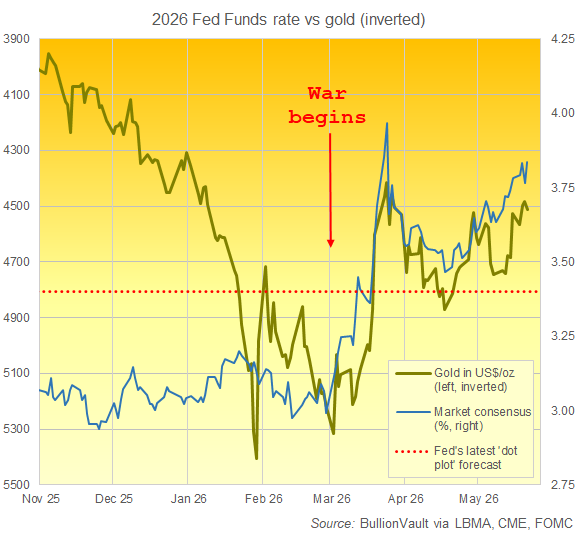
"Higher rate expectations since the escalation of tensions are weighing on sentiment," says commodities analyst Giovanni Staunovo at Swiss bank and London bullion clearers UBS, noting that gold prices are currently 16% below end-January's all-time highs.
"Over the medium term, we would still expect gold to rally substantially if geopolitical uncertainty remains high while interest rate expectations come down."
Minutes from last month's US Fed interest-rate decision last month − which ended with no change for the 3rd meeting in a row − showed on Wednesday that "Several participants [said] it would likely be appropriate to lower the target range for the federal funds rate once there are clear indications that disinflation is firmly back on track or if solid signs emerge of greater weakness in the labor market.
"[But] a majority of participants [said] some policy firming would likely become appropriate if inflation were to continue to run persistently above [the long-term target of] 2 percent."
The cost of living in the USA rose by 3.8% in April from 12 months before, the fastest annual pace since May 2023.
Two-fifths of the acceleration came from energy costs following the oil-price shock spurred by the US-Israeli attacks on Iran and Tehran's retaliatory air-strikes across the Middle East.
While US CPI inflation hasn't fallen below 2.0% since February 2021, it dipped below 2.5% per year in fall 2024, spring 2025, and again this New Year.
"To regain upward momentum," says the Wall Street Journal, "gold would likely need to see a significant easing in oil-driven inflation pressures or fresh evidence that slowing growth risks are beginning to outweigh inflation concerns."









 Email us