
Inflate Or Die
No, gold probably hasn't topped vs. stocks. Not yet...
TRYING for a base hit − a nickel here, a dime there − will probably not make an investor rich, writes Bill Bonner at Bonner Private Research.
He'll strike out from time to time too. What he needs is a home run, something he can get into fairly early, nod off, and wake up years later much wealthier. He needs a Primary Trend.
That is what he got from the flower of American industrial capitalism − from the moment Paul Volcker put inflation to flight in 1980...to the moment yields finally found their bottom in July 2020. That trend would have multiplied your wealth − either in stocks or bonds − for four decades. All you had to do was to sit tight.
What are the odds of a repeat performance?
They are probably very low. It is mathematically and physically impossible for asset values to become too far removed from the underlying economy for too long. Instead, they cycle up and down, anchored to the real economy by a long, bungee-like cord. So, if you're aiming for a long cycle of rising prices, your best bet is to grab ahold of the cord when it is stretched about as far as it can go to the downside, after a long cycle of falling prices.
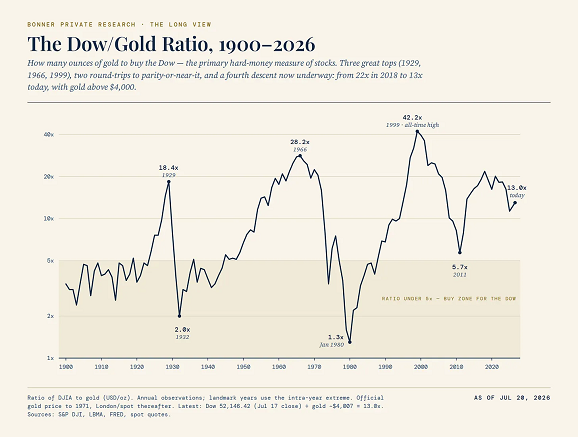
The Dow was under 1,000 in 1980. But today, it's over 50,000...higher than ever before. The most likely thing − though hardly guaranteed − is that stock prices will snap back down from here, in real terms, if not in nominal ones...and for a very long time.
Our favorite measuring stick is the Dow/Gold ratio. It measures the Dow stocks in terms of gold.
We expect Dow highs worth over 15 ounces of gold...and lows below 5. It's now around 13.
Still holding gold, we look for more stretch to the downside before we close our eyes and make the big trade − out of gold and into stocks.
That could happen either by gold going to $10,000...or the Dow stocks falling below 25,000. Most likely, they'll shake hands somewhere in the middle.
Just where they meet, though, depends to some extent on POTUS and the Fed. Trying to overthrow the election results might outrage the vox populi. But while most people might disapprove of efforts to manage or deny election results, they would cheer to the rafters any temporary measures that offered them lower mortgage payments.
Most people, endowed by Nature with the earnest faith of a friendly dog, believe an economy is adjustable...manageable...and improvable by PhD-bearing technicians in expensive suits.
That touching naïveté is what dug our present hole. Few protested in 1971 when Richard Nixon declared a series of new measures − including wage price controls and taking the US off the gold standard. They thought the economic bigheads knew what they were doing. And the New York Times − then as now, cheerleader for the feds − said the moves would only be necessary "until exchange rates realign."
They've been realigning ever since − almost all countries have raced to devalue their currencies to keep up with the US. If a nation allowed its currency to go up against the Dollar, it would make its own goods and services more expensive to foreign buyers and find its high-priced goods shunned on the shelves.
But inflation (the loss of purchasing power) encouraged bad habits − spending money we didn't have. It was also the real cause of the huge bull markets in stocks, bonds, and gold − 1980-2020. And now the bottom of the yield cycle has been passed and interest rates are going up. And debt has reached such levels − over $300 trillion worldwide − that even a modest twist on the interest rate screw sends the public howling for relief.
The authorities are cornered. Either they throttle back their spending. Or they 'print' faster and let the whole system go up in a blaze of glorious inflation later on.
It is either inflate...or die. Either allow more credit at lower rates to help cover the interest bill...or the bubble economy shrivels.
Most likely, as bubble death draws near, the feds will inflate...and inflate some more. And they will be heroes...for a while.










 Email us