
Gold Holds Up as Markets Reprice Fed Outlook Amid Worries Over 19-Year High Treasury Yields
GOLD and SILVER PRICES pared their post-Fed rally on Thursday, yet remained resilient after the Federal Reserve delivered a hawkish hold, while renewed Middle East tensions lifted oil prices and long-dated US Treasury yields climbed to a 19-year high. The latest moves come as investors reassess the outlook for further Fed tightening, with analysts pointing to relief buying in "overly shorted" precious metals while warning that the surge in long-term bond yields is "a real point of worry,” writes Atsuko Whitehouse at BullionVault.
Spot gold traded at $4079 per ounce after surrendering most of the nearly 1% gain recorded in the previous session, when the Federal Reserve left interest rates unchanged for a fifth consecutive meeting. The decision, however, carried a hawkish tone, with three policymakers dissenting in favour of a rate hike - more than markets had expected - while FRB Chair Kevin Warsh reiterated his commitment to "deliver price stability."
Silver also pared its post-Fed rally, easing to $58.09 after jumping as high as $59.23 immediately following the policy announcement.
The Dollar Index - a measure of the US currency against its major peers - recovered from a more than one-week low on Thursday, while the two-year US Treasury yield, which is highly sensitive to expectations for Federal Reserve policy, also rebounded after touching its weakest level in over a week.
The probability of the Fed leaving interest rates unchanged at its September meeting briefly rose to almost one-half immediately after Wednesday's decision – the highest in a week – before falling back to around one-third on Thursday, according to the CME derivatives exchange's FedWatch Tool, as markets reassessed the Fed's hawkish stance.
"Expect relief rallies in overly shorted and out-of-favour asset classes such as precious metals (and bonds) until the September FOMC meeting, or at least until Jackson Hole at the end of August," said Nicky Shiels, head of metals strategy at Swiss refining and finance group MKS Pamp.
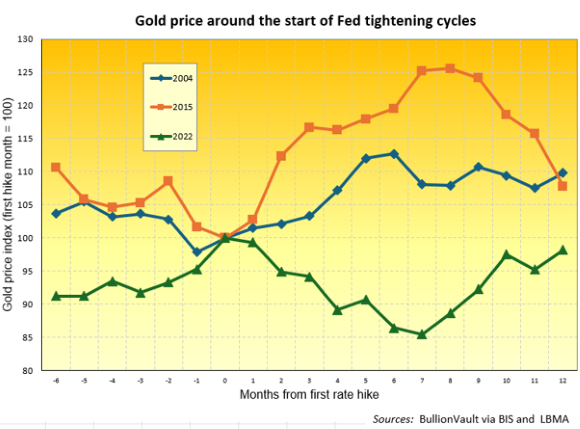
Historical experience suggests that gold does not necessarily decline once the Federal Reserve begins a tightening cycle. During both the 2004 and 2015 tightening cycles, gold prices weakened in the months leading up to the first rate increase as investors priced in tighter monetary policy. Once the tightening cycle began, however, gold stabilised and subsequently moved higher, suggesting that much of the impact of higher interest rates had already been priced in.
The 2022 cycle was different, as the Fed embarked on its most aggressive tightening campaign in four decades in response to the highest inflation since the early 1980s. Rapid increases in policy rates, sharply rising real yields and a stronger US Dollar continued to weigh on gold prices during the early stages of that tightening cycle.
In 2026, gold has also come under pressure following the outbreak of the US-Iran conflict, as the surge in energy prices fuelled concerns over renewed inflation and prompted investors to price in the possibility of a more hawkish Federal Reserve.
Gold and silver have fallen by more than 20% and 35%, respectively, since the start of the US-Iran conflict, reflecting a sharp correction after a strong rally. Even so, both metals remain up 22.9% and 53.9%, respectively, over the past 12 months.
Meanwhile, the US 30-year Treasury yield climbed further to 5.2% on Thursday, its highest level since 2007, extending the surge triggered by Wednesday's Fed decision.
"The jump in long-term bond yields would be a real point of worry," said Robert Sockin, chief US economist at PGIM, the global asset management arm of Prudential Financial, arguing that the biggest weakness of Warsh's press conference was his failure to explain why the Fed had not raised rates.
Referring to Federal Reserve officials, Sockin added: "They're going to be worried that they're losing credibility and will double down on the hawkishness in the coming weeks."
"Looking ahead, the case for a renewed advance in gold continues to strengthen," said Ole Hansen, commodity strategist at Saxo Bank.
"Growing concerns about fiscal sustainability, questions surrounding the Fed's policy credibility, robust physical demand from Asia and the prospect of a weaker US Dollar once markets begin to price in slower growth all provide increasingly supportive longer-term fundamentals," Hansen continued.
Attention now turns to today's release of the Federal Reserve's preferred inflation gauge, the core PCE price index. Economists expect underlying price pressures to ease modestly, with core PCE forecast to rise 0.2% month-on-month, down from 0.3% in May, while the annual rate is seen slowing to 3.3% from 3.4%.
Crude oil steadied after rebounding sharply from its worst three-day decline since 2020, with Brent climbing more than 7% in the previous session after the US military retaliated against Tehran's "surprise" ballistic missile attack following several days of paused hostilities.
The Bank of England, meanwhile, held its policy rate at 3.75% for a fifth consecutive meeting, maintaining a cautious stance as inflation remains above its 2% target.









 Email us