
Gold Rallies from 7-Month Low, SpaceX IPOs as Stocks Pay Lowest Dividend Ever
GOLD trimmed yesterday's dramatic $222 rebound on Friday, losing 3.9% for the week in London as Iran denied US claims that a new ceasefire deal is imminent, keeping the Strait of Hormuz shut to oil tankers as Elon Musk became the world's first trillionaire by floating less than 1/20th of his SpaceX group on the New York stock market.
"Textually, the agreement has almost been finalized in its major parts," said Tehran's Foreign Ministry spokesperson.
"[But] the problem is that the contradictory positions of the United States have always caused turbulence and disruption in this process," the statement went on − comments which US President Trump called "dishonorable...fake news."
After plunging Wednesday on US inflation data, gold cleared London's 3pm auction above $4190 per troy ounce, cutting the week's previous 7.8% plunge in half but also trimming its rebound from that day's 7-month low as crude oil rallied.
Existing US mega-cap tech stocks meanwhile headed for a weekly drop, with the Roundhill Magnificent 7 ETF (BATS: MAGS) losing 3.4% from last Friday's close as the world's largest-ever IPO valued SpaceX (Nasdaq: SPCX) at $1.8 trillion by floating less than 4.3% of its equity.
Applied to the whole business − now part of the tech-heavy Nasdaq index but excluded for 12 months from the broader S&P500 and, therefore, from market-tracking ETF funds such as the VOO and SPY − this week's initial price offering valued SpaceX at more than 90 years of the group's total sales with a price/earnings ratio of over 1,000.
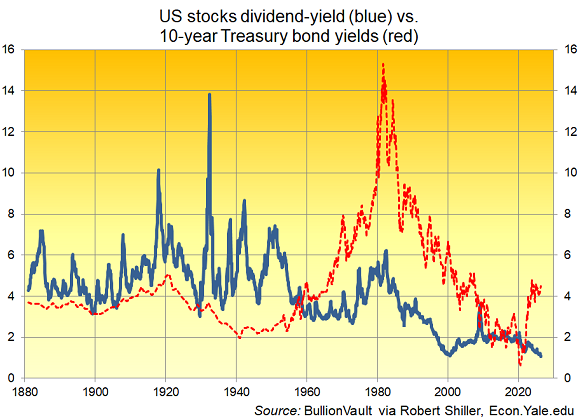
Shareholder income paid by the S&P500 constituents has now fallen to offer a dividend yield of just 1.08% per year − the lowest return in history according to data from Yale economics professor Robert Shiller.
Compared to the 4.50% per annum "risk-free" rate offered by US government debt today, that dividend-yield on the S&P500 is also now further below the yield on 10-year US Treasury bonds than any time since spring 2002 on analysis by BullionVault, when the US stock market was mid-way through its turn-of-the-century crash following the Tech Stock Bubble.
Back in precious metals today, tech-and-industrially useful silver had earlier fixed around $67 per troy ounce at London's midday market-clearing auction, sealing its 5th weekly fall in a row with a drop of 7.8% from last Friday's price.
Platinum prices lost 7.5% for the week, dropping back towards $1770 after rallying from Wednesday night's new 6-month lows.
Palladium fell the least of the 4 major precious metals, rallying above $1300 this morning before fixing with a 2.6% drop for the week around $1285.
Besides the SpaceX rocket-ship business, the listed corporation now trading as SpaceX also includes the social media platform X, the profitable Starlink satellite-telecoms firm, and artificial intelligence business xAI.
AI competitors Anthropic and OpenAI are expected to float a small portion of their equity at similarly huge valuations later this year.
Financial services firms are spending "hundreds of millions" on AI without knowing how to utilize the technology, according to "AI solutions" firm RWS, with 2 banks apparently spending $1bn "without generating a significant return on investment."
Launching the satellites for Starlink and other "mega-constellations" is creating an "unregulated geoengineering experiment" a scientific paper said last month, thanks to the quantity of black carbon put into the upper atmosphere.
The demise of these small, shorter-life quarter-tonne satellites then generates around 30 kilograms of aluminium oxide nanoparticles, a separate paper says.
Because the waste "may remain in the atmosphere for decades, [it] can cause significant ozone depletion."









 Email us