
Gold and Silver Leap as Crude Oil Sinks on Trump's Deal with Iran
GOLD and SILVER surged on Monday as crude oil tumbled and global stock markets leapt with bond prices after the US and Iran announced an interim deal to end hostilities and reopen the Strait of Hormuz, slashing expectations that the Federal Reserve will start to raise US interest rates this fall, writes Atsuko Whitehouse at BullionVault.
"Ships of the World, start your engines. Let the oil flow!" said President Trump on Sunday of the agreement brokered by Pakistan, confirmed by Iran's deputy foreign minister, and set to be signed this Friday in Switzerland.
Details of the Memorandum of Understanding have yet to be released.
But the 14-point plan matches a version published by Iranian media on Friday, those same sources now say, infuriating hard-line politicians in both Washington and Tehran.
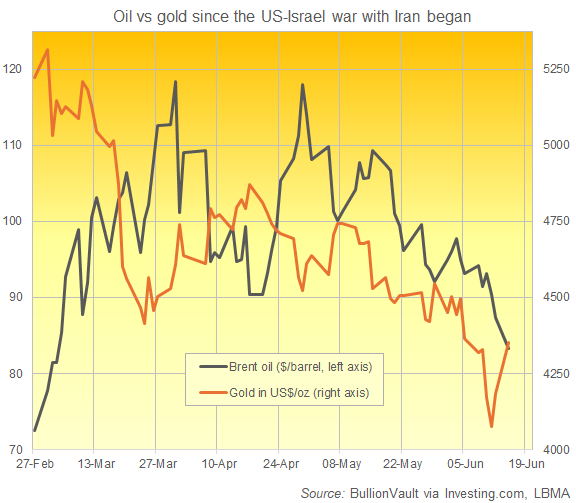
Wholesale bullion gold prices leapt at the start of Monday's Asian trading, opening the week $90 per troy ounce higher before extending that jump to 3.8% and touching 1-week highs above $4345 by lunchtime in London.
Oil in contrast fell nearly 5% to hit 3-month lows, with August futures for Brent crude dropping through $83 per barrel on the ICE derivatives exchange for the first time since 10 March.
With natural gas prices also retreating hard on news of the US-Iran agreement, betting that the Federal Reserve will raise overnight interest rates as early as October fell to its weakest so far this month, putting the odds at less than 2-to-1.
Expectations for a rate rise at December's Fed meeting also fell back, trading at barely 50-50 after reaching a 71% certainty this time last week − when strong US jobs data saw gold crash through the 200-dma "supporting" uptrend − according to derivatives exchange the CME's FedWatch tool.
Since the US-Israel conflict with Iran began on the last day of February, crude oil had climbed 63.3% by the end of March and was still 14.9% higher on Monday morning.
Gold moved in the opposite direction to oil, falling as much as 22.0% from the eve of the war by last Thursday's 7-month low, before paring that decline to 16.9% today.
Like gold, silver today reversed what remained of last week's steep plunge − made after US CPI data put inflation at a 3-year high driven by rising energy costs − to trade back above $71 per troy ounce.
Despite rumors that the US-Iran MOU includes an end to fighting in Lebanon, "We are not partners to this agreement," said Israeli National Security Minister Itamar Ben-Gvir today, and "We will have to continue the campaign to bring down the [Iranian] regime ourselves," said Finance Minister Bezalel Smotrich − like Ben-Gvir, now personally sanctioned by the UK, Australia and Canada and 7 other countries for inciting violence against Palestinians in the West Bank.
Those same countries have long imposed sanctions against Iran's theocratic regime, alongside the Unites States, all European Union members, plus Japan and South Korea.
"Resistance levels in gold prices remain intact, and investors are likely to stay cautious in the near term," says London bullion clearing bank ICBC Standard, part of China's giant ICBC, citing uncertainty over whether the 60-day negotiations on Iran's nuclear programme − scheduled as part of this new ceasefire agreement − will result in a permanent deal, as well as how quickly regional energy supplies and shipping through the Strait of Hormuz can normalise.
Today's surge in gold prices followed Friday's sharp rebound from Wednesday night's 7-month lows, rising alongside Western stock markets amid the record IPO of Elon Musk's SpaceX (Nasdaq: SPCX).
The Dollar Index – a measure of the US currency's value against its major peers – today edged down 0.2% to a one-week low, while the annual yield to fixed-income investors buying 10-year US Treasury bonds fell 4 basis points to a five-week low of 4.44% as bond prices rose.
European stocks also gained rose Monday, with the pan-European STOXX 600 up 0.7% following strong gains in Asian equity markets.
Japan's Nikkei 225 closed at a record high, rising 5.0% for the day, while South Korea's Kospi gained 5.2% to reverse most of last week's plunge from new all-time highs, made on "concerns that valuations [in semi-conductor stocks] have already priced in much of the rosy outlook," according to analyst Yang Hyeong-mo at brokerage DS Investment & Securities.









 Email us