
Gold and Silver Jump as Beijing Vows to Support China's Stock Market
GOLD and SILVER PRICES jumped early Friday, trimming that move in London trade but sealing their first weekly gains in three as global stock markets also rose following a promise of "support" for Chinese equities from the Communist government in Beijing.
Shanghai's CSI300 index leapt 4.2% from this week's 17-month lows, while the MSCI World Index of high-income countries' stock markets rose to show a 4.2% gain for the week, cutting last week's 'everything crash' in half.
Gold and silver meantime traded 6.0% and 15.1% respectively above Wednesday's new 15-month spot market lows in precious metals, both reversing 1/5th of last week's steep plunges.
Gold for London settlement peaked at $3685 per troy ounce as the City opened for business after the price in China's wholesale market jumped 2.4%, the sharpest gain in more than 3 weeks.
But while that rebound put Chinese prices more than $22 per troy ounce above London quotes − matching the largest incentive for new imports into the precious metal's largest consumer nation since end-September − it came on the lowest trading volume in a fortnight at both the Shanghai Gold Exchange and the Shanghai Futures Exchange.
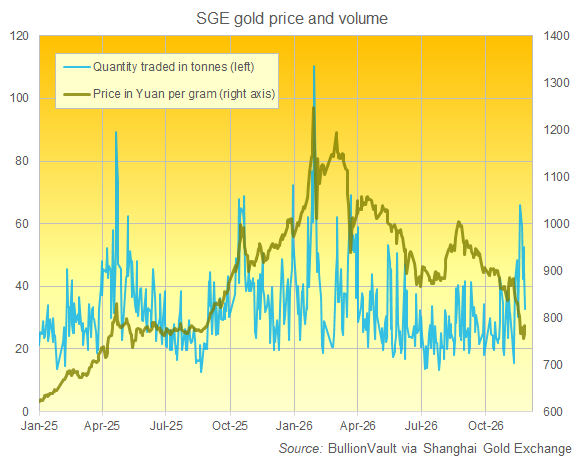
Shanghai's physical silver trading exploded in contrast, with volumes in contracts for the more industrially-useful precious metal setting the largest volume at the SGE since early May as prices leapt by 8.2%, the steepest 1-day jump since March.
US trading volumes were likely to stay low on Friday as the Black Holiday shopping spree followed yesterday's Thanksgiving holiday into a long weekend.
With Chinese house prices continue to deflate as equities have fallen, "The capital markets are crucial to overall economic development," announced Beijing's State Council after an executive meeting today.
Led by Premier Li Qiang, the Council is urging listed companies "to increase dividend payouts and share buybacks" while the government itself will "provide ample liquidity guarantees" and push the so-called 'national team' of role of state-owned enterprises into "stabilizing the market" by funneling insurance funds, corporate annuities and social security reserves into the equity market.
"In a landscape of [Communist] party leadership transition next year," says Swiss bank Julius Baer's head of research in Hong Kong Richard Tang, the financial markets' focus will be on "whether Beijing intends to stimulate the economy" ahead of the 21st Party Congress set for late-2027.
That will start proceedings for China's "tightly choreographed, twice-a-decade top reshuffle," explains Australia's SBS News, "when President Xi is expected to extend his rule for another five-year term."
Xi Jinping effectively became president for life in 2018, six years after first taking office. This week his 14-year long "anti-corruption" purge of political rivals claimed potential successor, Politburo member and Shanghai party secretary Chen Jining.
"Millions of CCP members and officials have been caught up in Xi's anti-graft campaign," says SBS. "Recently, a record 33 dignitaries were expelled when the CCP's powerful Central Committee gathered."
China's futures trading was also strong Friday in platinum-group metals, with volumes at the Guangzhou Futures Exchange − today marking the first birthday of GFEX platinum and palladium contracts − running 40% and 52% respectively above the 12-month average.
The price of platinum − which finds rose further in London trade, peaking at 1-week highs close to $1370 per troy ounce before falling back $40 as gold and silver retreated.
Palladium hit a 1-week high too, touching $924 per ounce before giving back $30 but also showing a 5-session rise for the first week in three.
Wednesday this week saw gold fix below $3500 per ounce at London's benchmarking auction for the first time since 2 September 2025, while silver fixed below $40 for the first time since 29 August last year.









 Email us