
Gold, Silver Give Back Peace-Deal Rebound as Hawkish Fed Drives Dollar to 1-Year High
GOLD and SILVER pared their rebound by Thursday lunchtime as the US dollar surged to a one-year high, overshadowing support from the newly signed interim US-Iran peace deal, while crude oil fell to its lowest level since the Iran war began after an interim ceasefire reopened the Strait of Hormuz. The move followed the Federal Reserve's hawkish turn, writes Atsuko Whitehouse at BullionVault.
The Bank of England (BoE) held its interest rate at 3.75% on Thursday, following the US Federal Reserve's decision to keep rates at 3.50 - 3.75% last session. The hold comes as UK inflation unexpectedly held steady at 2.8% year-on-year in May and private sector wage growth slowed to its lowest rate in more than five years in April, according to data published this week.
The US central bank, meantime, removed language suggesting future policy easing from its statement, while the median FOMC projection swung on Wednesday from one rate cut in March to one rate hike before year-end.
Spot gold gave back its earlier gains this morning, slipping to $4248 per ounce by London lunchtime after rebounding as much as 2.6% from the previous day's low. The yellow metal had plunged more than $160 in the wake of Wednesday's Federal Open Market Committee (FOMC) meeting.
“The hawkish shift has limited upside in gold prices, even as the US and Iran reached an interim peace agreement,” says a trading note from London bullion clearing bank ICBC Standard, part of China's giant ICBC.
The US Dollar Index surged to its highest level since May 2025, while two-year Treasury yields held near a 16-month high after jumping last session, adding further pressure on gold and silver following the Fed's hawkish shift.
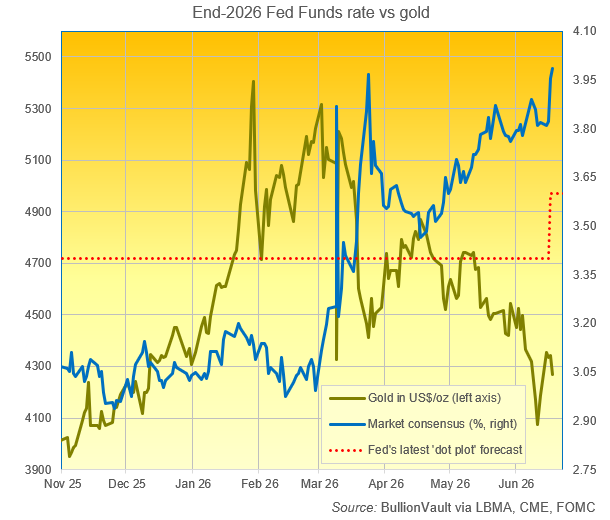
The odds of an October rate rise – seen as less than a 35% probability one month ago – have now risen to more than 70%, according to betting on interest-rate futures.
Market consensus on Thursday put Fed rates finishing 2026 at 3.98% — nearly one percentage point higher than the level forecast at the start of this year, when the US central bank's own "dot plot" projected rates would fall to 3.40% by year-end.
"There is no reason to revisit the 2% objective until we've reached it," Fed Chair Kevin Warsh said in his first post-FOMC press conference, while policymakers raised their median year-end PCE inflation forecast to 3.6% year-on-year from 2.7% in March.
“Hawkish, full stop,” said Nicky Shiels, head of metals strategy at Swiss refining and financial services group MKS Pamp, referring to Wednesday's FOMC statement, policymakers' projections and comments from new Fed Chair Kevin Warsh.
Oil prices fell further on Thursday after US President Donald Trump declared "It's signed" late Wednesday, confirming that the memorandum had been electronically signed by both sides and hailing it as a breakthrough that would reopen the Strait of Hormuz and pave the way for de-escalation.
August Brent crude futures fell more than 2% to $78 per barrel on the ICE derivatives exchange for the first time since 2 March, paring almost all gains made since the Iran conflict began.
European natural gas prices steadied on Thursday after falling to their lowest levels in more than a month last session, as markets continued to react to developments surrounding the US-Iran peace agreement and the prospect of improved energy flows from the Middle East.
While the 14-point MoU offers sanctions relief if Iran "behaves," Trump warned that US military strikes could resume if Tehran fails to comply. The memorandum is not a final agreement, however, with both sides set to enter 60 days of further negotiations.
London silver bullion prices erased all of today's earlier gains, having rebounded as much as 4.5% to $69.83 per ounce from Wednesday's low. It came after a 6.6% drop in the wake of the hawkish FOMC decision.
Gold prices in Euros and UK Pounds per ounce, meantime, held above one-week highs at €3706 and £3213, as both currencies weakened to a two-month low against the US Dollar on Thursday.
European stocks fell, with the pan-European Stoxx 600 edging lower by 0.6%, while the UK's blue-chip FTSE 100 index fell 1.1% following the policy decision. BoE Governor Andrew Bailey said he was willing to temporarily tolerate above-target inflation, but would respond "promptly" to any signs of widening inflationary pressures.
US stock futures rebounded on Thursday, with S&P 500 futures climbing 0.7% and Nasdaq 100 contracts rallying 1.4%, after both had fallen more than 1% in the previous session following the hawkish policy meeting.
Fed Chair Warsh unveiled five task forces on Wednesday (covering inflation, productivity and jobs, communications, the balance sheet, and data), while rejecting forward guidance and leaving markets to speculate on the future direction of Fed policy.
"The five task forces were the main surprise," commented Shiels, adding that the initiative may create a near-term policy vacuum as many questions are deferred to future working groups.









 Email us