
Gold Extends Longest Drop in a Decade as Diesel Rises Despite Trump's Russia Deal
GOLD PRICES reversed earlier gains on Monday as crude oil rose and diesel prices rebounded despite President Donald Trump's efforts to calm energy markets by easing sanctions on Russian diesel and announcing what he described as an energy ceasefire between Russia and Ukraine, writes Atsuko Whitehouse at BullionVault.
Spot gold prices in London fell 0.3% to $4174 per ounce by Monday lunchtime after recording the seventh consecutive weekly decline in US Dollar terms, based on the market center's afternoon benchmarking auction price.
That marks the longest weekly losing streak in gold prices since Trump's first presidential election victory in late 2016.
"Gold has remained under pressure as continued tension in the Middle East pushes oil prices higher," says German precious metals refining group Heraeus in its latest weekly note.
Brent crude oil futures rose 1.3% by Monday lunchtime in London as oil supply concerns intensified after Yemen's Iran-backed Houthis claimed responsibility for Saturday's deadly attack on Riyadh airport and also claimed to have struck two key facilities of world No.1 oil company Saudi Aramco.
US diesel futures rebounded on Monday as renewed Middle East tensions heightened supply concerns, recovering some of Friday's 3% decline to $4.74 per gallon.
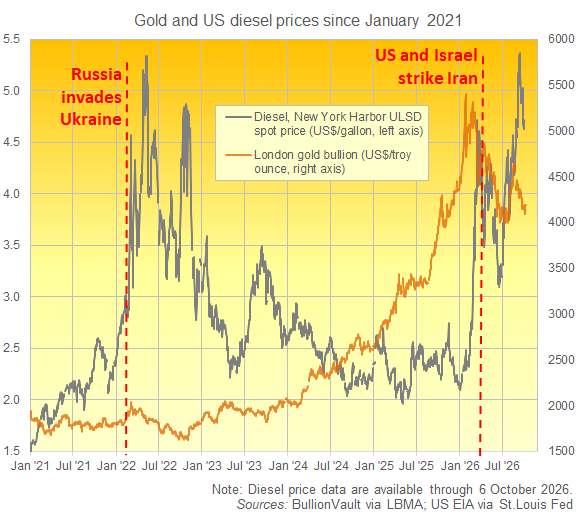
Friday's fall followed President Trump's announcement of sanctions relief for Russian diesel, a move which itself followed the close link between rising diesel prices and Democrat polling to win next month's mid-term elections.
Trump then announced an 'energy ceasefire' between Russia and Ukraine over the weekend − a move not confirmed by Moscow and met with surprise by Kyiv.
Platinum, which derives two-thirds of its demand from industrial uses led by auto-catalysts, most especially for diesel engines, rose 0.3% on Monday morning to $1692 per ounce, still near its lowest level in more than 7 weeks.
The price of 'sister' metal palladium – which derives well over 4/5ths of its end-use demand from auto-catalysts to reduce harmful emissions from gasoline engines – rose 0.2% to $1156 per ounce after recording its lowest level since September 2025 last Wednesday.
The Dollar index – a measure of the US currency's value versus its major peers – meanwhile steadied near its highest level in 18 months, while the US bond market was closed for Columbus Day.
Trump's diesel deal with the Kremlin envisages immediate supplies of more than 300,000 tonnes to US and global markets, followed by 500,000 tonnes in November and 1 million tonnes in December.
The US Treasury temporarily authorised Russian diesel imports until 7 April 2027. A shipment of 300,000 tonnes – equivalent to approximately 2.24 million barrels – would amount to less than one day's diesel consumption by the US transportation sector alone, which averaged 2.94 million barrels per day in 2025, according to the US Energy Information Administration.
Silver, which derives nearly 60% of its annual demand from industrial uses, rose 0.9% to $60.75 per ounce by Monday lunchtime.
The rise in silver prices followed the grey metal's third consecutive weekly decline, which took it to its lowest level in more than 9 weeks based on London's benchmarking auction price.
Delegates at this year's LBMA/LPPM annual precious metals conference, held in Sorrento last week, forecast gold prices at $5113.10 per troy ounce by the next conference in Austria in October 2027, with silver at $97.40, platinum at $1913.50 and palladium at $1415.70.
A further Saudi airport attack on Sunday, plus Trump's suggestion that the US could join Saudi strikes against the Houthis, have heightened fears of a wider conflict. Diesel prices surged since the US-Israeli war with Iran began to disrupt shipping through the Strait of Hormuz.
Prices temporarily eased in July as crude oil became cheaper following the US-Iran ceasefire and a partial recovery in Gulf shipments. But refining disruptions persisted, and New York Harbor spot prices in September topped the highest monthly average recorded in 2022 following Russia's invasion of Ukraine.
Ukrainian strikes on Russian refineries and Moscow's fuel export restrictions have since continued to constrain global supplies.










 Email us