
Gold Extends Rally as Government Debt Concerns Mount
GOLD PRICES rose to their highest level in more than three months on Monday amid continued concerns over rising government debt across major economies and ongoing US policy uncertainty. Markets are awaiting details of Washington's new sanctions on Iran while US–Canada trade tensions escalated over the weekend, writes Atsuko Whitehouse at BullionVault.
Spot gold was up 1.9% to its highest since mid-May at $4670 per ounce at London lunchtime, after rising more than 13% over three consecutive weeks on the LBMA Gold Price PM basis - gold's strongest three-week advance since the Covid-driven rally of July–August 2020.
The price in Euros and UK Pounds meanwhile, also rose to three-month highs, gaining 2.0% to €4002 and 1.9% to £3423 per ounce respectively, after both recorded three consecutive weekly gains totalling more than 11%.
Data released on Friday showed that UK public debt stood at £2.98 trillion (about $4.1 trillion), or 94.1% of GDP, at the end of July, providing another reminder that mounting government debt is not solely a US concern. The US national debt exceeded $40 trillion (around 123% of GDP) on 19 August.
“I see the US and other countries headed toward having the equivalent of economic heart attacks,” warned billionaire investor Ray Dalio, founder of Bridgewater Associates, who has argued that mounting government debt is a problem extending beyond the US to other major economies, including the UK, Europe, China and Japan.
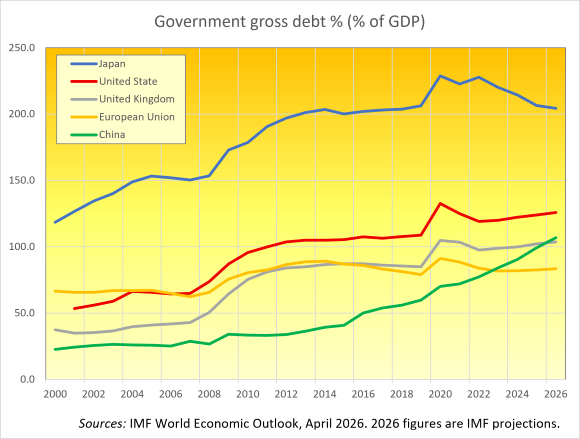
Government debt as a share of GDP has been rising in several major economies, although trends differ by country. IMF data show the ratio rising steadily in both the US and UK since 2022, while the Euro area has returned to an upward trend since 2023. China's debt ratio has been on a much longer upward trajectory since 2012. Japan remains an exception, with its debt-to-GDP ratio falling since 2022 - though at around 204% this year, it remains by far the highest among the economies shown.
The cost of servicing government debt is also becoming increasingly significant. The Congressional Budget Office (CBO) projects US net interest payments at more than $1 trillion in 2026, equivalent to around 19% of federal revenues. By 2036, that figure is projected to rise to 4.6% of GDP — equivalent to roughly one-quarter of projected federal revenues.
In the UK, the Office for Budget Responsibility (OBR) forecasts debt-interest spending of £109 billion (about $149 billion) in 2026/27, or roughly 9% of government revenue.
“Our experience over the last few years suggests that concerns over the debt mountain – in the US and elsewhere – remain one of the pillars of gold demand, and any attempts to manage that burden without reducing debt or deficits are likely to continue favouring gold,” said the mining industry’s World Gold Council.
Investors as a group sharply expanded their position in giant gold-backed ETF the SPDR Gold Trust (NYSEArca: GLD) last week, with the fund growing 2.3% to reach 1,047 tonnes, its largest size since late April. That marked a third consecutive weekly inflow and the biggest weekly gain since October 2025, when the yellow metal was setting fresh record highs.
The smaller iShares gold product (NYSEArca: IAU) also grew 0.5% to 458 tonnes last week, its first weekly increase in four weeks, while silver's largest such ETF - the iShares Silver Trust (NYSEArca: SLV) - saw its first weekly liquidation in four weeks, shrinking 0.1% to 15,295 tonnes.
Prices for silver, primarily an industrial metal which finds nearly 60% of its annual demand from industrial uses, meantime steadied at $69.52 per ounce, after gaining more than 19% over the previous three weeks.
US policy uncertainty also remained in focus, with markets awaiting details of Washington's new economic sanctions on Iran after Treasury Secretary Scott Bessent pledged the “toughest sanctions in history”. Separately, trade tensions with Canada escalated after negotiations broke down on Friday, with new 50% US tariffs on some $20 billion of Canadian goods prompting Ottawa to announce dollar-for-dollar retaliatory measures from 8 September.
The US Dollar Index meanwhile rose 0.2% but remained near its lowest level since late May, while benchmark 10-year and 30-year US Treasury yields both fell around 4 basis points. The 30-year yield nevertheless remained close to its highest level since 2007.
Elsewhere, Bitcoin rose 1.2% to around $78,000 on Monday, after gaining 22% last week in its strongest weekly advance since March 2024.











 Email us