
Gold Slips But Soaring Debt 'Supports Price' as Oil Slides, Bond Rates Ease
GOLD PRICES slipped and silver rose on Monday as the US Dollar neared 2-month highs following last week's Federal Reserve interest rate rise but long-term bond yields edged lower, easing the cost of servicing Western government debt from multi-decade highs, writes Atsuko Whitehouse at BullionVault.
Crude oil fell for the 4th session running, with Brent futures down 1.9% after US President Trump said he's open to meeting Iranian President Masoud Pezeshkian in New York this week, raising hopes of diplomatic progress in the Middle East war.
Spot gold prices fell as low as $4340 per troy ounce before rallying to Friday's London auction price of $4349 after recovering from new 6-week lows following the "hawkish" US Fed policy meeting.
The Dollar index – a measure of the US currency's value versus its major peers – edged up to its highest since the end of July, following last week's Federal Reserve rate rise and "hawkish" comments.
But US Treasury bond prices rallied across the board, pushing down the yield offered by Washington's 10-year debt – a benchmark rate for government as well as many financial and commercial borrowing costs – back below 5.00% per annum, the highest since summer 2007.
High bond yields would normally be negative for gold, but this month's jump is "more a reflection of fiscal deficits, heavier issuance and a higher term premium" than a traditional Fed-driven rates story, says Daniel Hynes, commodity strategist at ANZ.
"This helps explain why gold's inverse relationship with US yields has weakened since 2022," Hynes says.
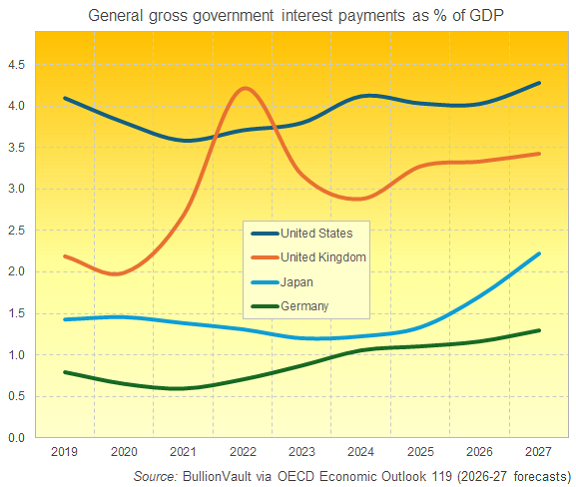
Data from intergovernmental think-tank the OECD says gross interest payments on outstanding debt were equivalent to 4.0% of US GDP and 3.3% of UK GDP in 2025, rising to around 4.3% and 3.4% respectively by 2027 as maturing debt is refinanced at higher borrowing rates.
That compares with defence spending at 3.2% and 2.4% of GDP respectively according to the Nato military alliance of Western nations.
Germany's interest burden remains the lowest of the "rich" world's 4 largest economies, but is also projected to rise from 1.1% of GDP in 2025 to 1.3% by 2027.
Japan stands out with a sharper projected increase, going from 1.2% in 2024 to 2.2% by 2027 as the Bank of Japan ends its exceptionally loose monetary policy.
Ten-year yields on inflation-protected US Treasury bonds also retreated on Monday but "have hit a 20+ year high" this month, says Ole Hansen, head of commodity strategy at Saxo Bank.
"Yet gold ETF holdings continue to rise...a striking break" from gold's traditional inverse relationship with real yields.
"This suggests investors increasingly view rising yields as a signal of fiscal and debt risk rather than simply an attractive alternative to gold."
The giant SPDR Gold Trust (NYSEArca: GLD) last week expanded 0.9% to need 1,057 tonnes of bullion backing, the most in 5 months.
World No.2 gold ETF the iShares Gold Trust (NYSEArca: IAU) also grew, expanding 0.6% with its 2nd consecutive weekly increase.
Gold demand also showed strength last week in China, the world's No.1 gold consumer, miner and importing nation, with prices on the Shanghai Gold Exchange averaging a premium over London quotes of nearly $16 per troy ounce, up nearly 4-fold from the previous week's incentive for new bullion imports.
But the SGE premium eased to $6 on Monday, around $1.50 below its historical average, ahead of this week's US-China summit between Presidents Trump and Xi, with trade, Iran and other geopolitical issues on the agenda.
Contrary to gold meantime, the price of silver − which finds nearly 60% of its annual demand from industrial uses − today rose as much as 1.2% to $67.05 per troy ounce before edging back towards Friday's close.
Fellow industrial precious metals platinum and palladium also rose oil prices and long-term borrowing costs eased, rising 4.4% and 3.6% respectively from the 2-week and 6-week lows hit on Wednesday's US Fed rate rise to trade around $1812 and $1309 per troy ounce in London on Monday lunchtime.









 Email us